Annual Report 2005
The aim of the Ewoi programme is to assist the poor old needy people in Lodwar and surroundings.For the old people, hunger and health problems are the most common problems.
Other problems are housing, lack of beddings, utensils, etc.
During the year 2005, more parents came to the Ewoi programme seeking assistance for their handicapped children. The programme tried to help those children as much as possible. See chapter "handicapped".
Clients
The programme has 199 participants in Lodwar town, and is dealing with about 700 clients in the whole district.
The aim of the programme in 2005 was to increase the intake of clients. Therefore the staff had to make a rule that the home visitor and the social worker are required to visit the new clients, in order to find out the details of the home situation of each client.
When the network of the client is clear, than the decision is made if he/she will get an intake number. But sometimes when there is an emergency case; we have to take action immediately.
From Lodwar Town, 12 clients died.
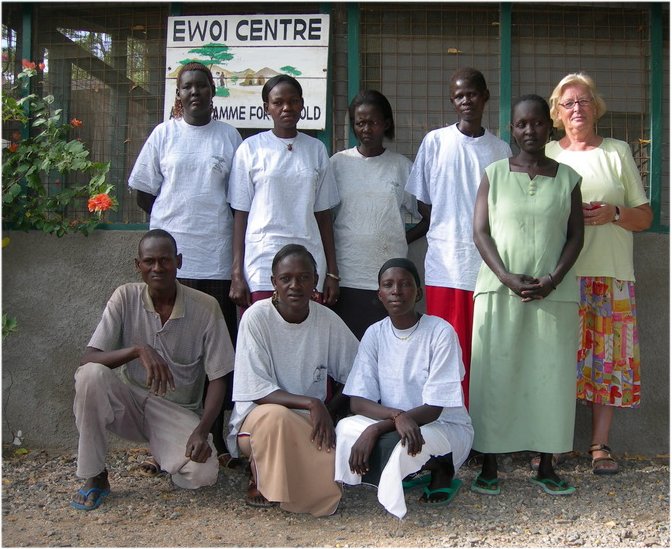 Staff
In the year 2005 the programme was staffed by:
1 co-ordinator
1 assistant co-ordinator (from July 2005)
4 home visitors
1 social worker
1 informal social worker
1 nurse, part time
3 watchmen.
The staff is hard working and committed. Most are women. If they do their job well, the programme tries to sponsor them for training.
A former office assistant finished her secretarial course and was appointed as the assistant co-ordinator on 1 July 2005.
A home visitor will finish her nursing training in March 2006, and another one joined the same training in February 2005.
One staff member attended a one month workshop about VTC (Voluntairy Testing and Counseling) for HI/Aids.
One home visitor finished a one year " distance course" of community work and social development in December 2005.
The staff dealt with 2686 who came to the office asking for general assistance.
Home visits
The home visitors visit their clients regularly. The frequency depends on the problems of the client. The home visitors only work in the morning because in the afternoon it is too hot for going around. The clients appreciate the visits very much. In many cases, the home visitor is the only one who is interested in the well being of the old one.
The nurse and the social worker visit the clients if special assistance is needed.
The home visitors and the social worker made 4801 to the clients.
Food
Most of the clients don't get enough food. They depend on the food given by relatives and neighbours. In severe cases, the Ewoi programme tries to assist. Every week about 70 clients get food from the office, 1.3 kg maize/beans 1.3 kg flour and once a month ¼ ltr. oil and a small packet of salt.
When a client falls sick and he/she is getting strong medicine, then they get food. For special cases also the programme has supplied food.
A few times the diocese has given food to the programme; but there was no food from the government or any NGO at all.
The programme has bought food most of the time.
Food distributions in the villages are rare; only during the referendum there was some food distribution, but our clients were not among the lucky ones. 3108 Times the office have given out food to the clients.
407 clints came to the offce askinf for food but there was no reasen to give them food.
Medical
During the whole year, a qualified nurse has done the medical department. It is very difficult to get nurses and keep them for a long time in the programme. The NGO's can afford to pay high salaries, so nurses switch very easily to a job offered by an NGO.
During the year, nurses from the hospital who had their annual leave, worked in the programme on a part-time basis.
The nurses treat the sick clients in the office. They do "follow ups" and visit the sick, old ones at home, accompanied by the home visitor.
Mobile clinics
The mobile clinics are still going on every month. The clinic in Kalokol especially is very useful. Many old people were sick and hungry. All the attendants too got some food.
Through health talks, every month, the hygiene has improved. A few times we distributed soap to the old ones.
Eye Camp
Thirty-nine clients attended the "eye camp" in Lokitaung - held by Spanish eye doctors. Two staff members of the programme took care of the clients for two weeks.
Several of the attendants went to the eye camp, blind. After undergoing an operation they came back, seeing. Others got medical treatment.
Hygiene
During home visits, the home visitors taught the clients the importance of cleanliness, personal and environmental and other medical items. If there is no other possibility, the home visitors cut nails and hair and assisted them in taking a shower.
| 747 97 288 108 10 1.011 12 |
clients got medical care in the office clients were treated at home by the nurse home visits by the nurse to do "follow ups" referred to the hospital clients were admitted in the hospital clients attended the mobile clinic clients died in Lodwar Town |
Activities
The following activities were carried out:
- In June 2005 the Bishop appointed a Board of Management. They have Held meetings on two occasions.
- The programme built 18 houses for destitute clients.
- The programme organised a Christmas celebration for all the clients.
- Every week there was food distribution to an average of 70 clients
- The clients got soap once a month; and when it was necessary the needy ones got clothes, bedding, utensils etc.
- Regularly an orthopaedic technician assisted clients with artificial limbs, orthopaedic equipment and wheelchairs.
- For the members of the Small Christian Communities the programme organised a two day workshop on five occasions. The members were taught about awareness of the needy old people in their community and how to help them.
- The programme provided wheelchairs, walking frames and other medical equipment, which were sent from the Netherlands.
- The programme organised a survey in December 2004 to assess the nutritional status of the clients.
- The programme surveyed the compound in Kanamkemer and made an agreement with the caretaker of the compound.
- The programme continues the adult education of two handicapped clients (special cases).
- The programme organised an eye clinic for the old people in Kalokol, in co-operation with the Spanish eye doctors.
- Thee programme is still trying to build up "cost sharing" for clients who are able to pay something.
- The programme is sponsoring two students for nursing.
- The programme organised three workshops for the staff members about counselling, HIV/aids awareness and the Proposed New Constitution for Kenya.
- The programme kept regular contacts with the Chancellor of the Diocese, District Officer, Forest office, Chiefs, Social Ministry, Social service, Hospital, Liliane Foundation, Help Age, Dispenseries, Police, Justice and Peace, and other public institutions to facilitate the smooth running of the programme.
- The programme organised an outing for the staff on two occasions.
Handicapped
At the end of 2005 the programme had assisted 30 children, who got attention from the orthopaedic technician. Some got an artificial leg, callipers, crutches, polio boots or other aids.
Liliane Foundation is sponsoring these children.
A staff member of the Ewoi programme is involved in these activities.
Transport
The programme was using the private car of the Co-ordinator. Through Miva and friends and well wishers from the Netherlands, the Ewoi programme was enabled to buy a new car - a Toyota Hilux, four wheel drive, single cab. It is a great improvement. It is now much easier to reach clients in the rural areas, to transport people in a more comfortable way and undertake other activities.
The home visitors are still using bicycles (mountain bikes) to go to the villages. Every morning a technician comes to the office to service the bicycles.
Finance
Until now, it has not been possible to find a sponsor for the long term. However, through well wishers from abroad and all the Benefacteries from everywhere, the Ewoi programme has been able to continue. We are very grateful for that.